

Poolie Team: Nov 06, 2026
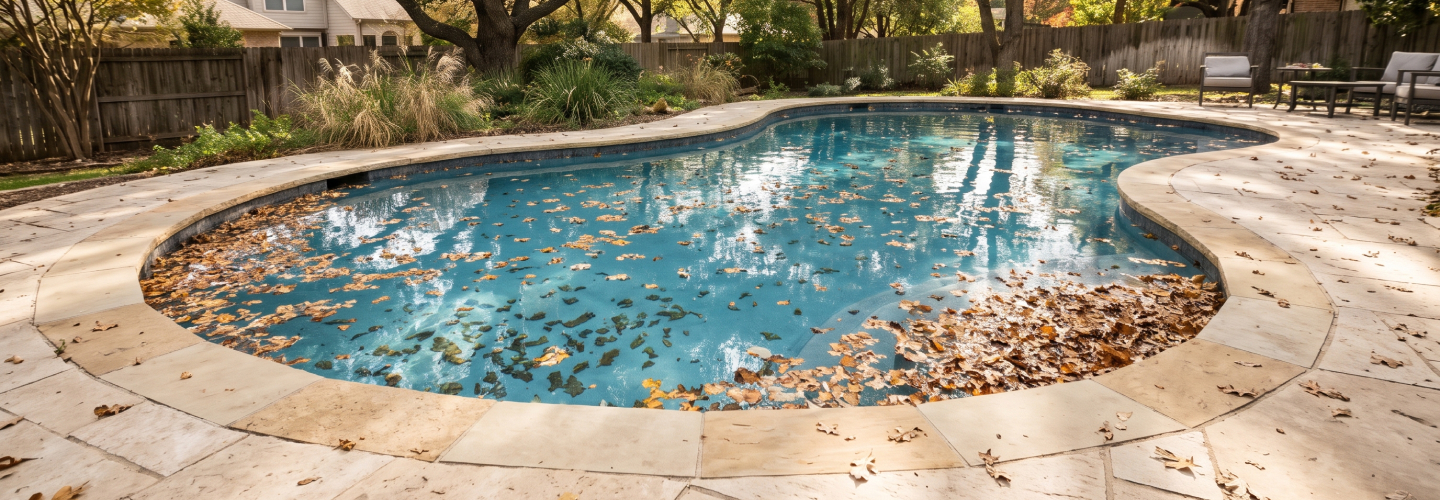
You checked your pool on Sunday and everything looked fine. By Tuesday, your skimmer basket was packed so tight you could barely pull it out. That’s how quickly fall debris can accumulate in Texas, and if it caught you off guard, your cleaning routine may already be falling behind.
Leaves and other debris can ruin the appearance of your pool, but there’s more to it than that. When layers of leaves accumulate at the bottom of your pool, they begin to decompose and release organic compounds into the water. This can increase chlorine demand, contribute to discoloration, and create conditions that make algae growth more likely if sanitizer levels aren’t maintained. In many parts of Texas, pool water can also remain warm enough for algae growth well into fall.
This guide covers what fall debris does to your equipment and water chemistry, how to skim a pool efficiently when the volume spikes, and when the workload has outpaced what you can handle on your own.
Why Fall Pool Debris Can Be a Challenge for Texas Pools
Fall pool debris can become a major maintenance challenge for Texas pools because some trees and plants can shed large amounts of organic material over a relatively short period. Windy weather and cold fronts can also move debris into pools quickly.
Texas is home to some heavy shedders. Pecan trees can lose substantial foliage later in the season, and other deciduous trees may drop leaves throughout fall. Live oaks are different: Texas A&M notes that their major annual leaf drop typically occurs in late winter and spring as new growth emerges.
The exact timing depends on tree species, weather, drought stress, and location. In 2026, for example, Texas A&M Forest Service reported that drought and extreme heat caused some hardwoods in Central and East Texas to enter dormancy and shed leaves earlier than usual.
When seasonal leaf drop coincides with strong winds or cold fronts, debris can accumulate quickly. When leaves hit the water faster than your skimmer and manual cleaning routine can remove them, baskets and circulation pathways can become restricted. That’s when equipment performance can start to suffer.
The Domino Effect: How Leaf Overload Chokes Your Pool Equipment
What most pool owners don’t realize is how leaf overload can affect their pool equipment: a blocked skimmer basket can restrict water flow and put additional stress on the circulation system if it is not cleared.
Skimmer-Basket Overload
A few hours of heavy leaf drop can create a dense mat of leaves around the skimmer opening. Once that mat forms, water flow through the skimmer can become severely restricted. This reduces circulation and may limit how effectively your system filters the water. If the main drain and other suction lines can’t compensate, overall circulation can drop significantly, increasing the risk of stagnant areas and algae growth.
During peak drop season, checking your skimmer basket once a week may not be enough. Check it as often as the debris load requires, which can mean daily during a heavy leaf drop or after strong winds.
Restricted Water Flow and Pump Stress
When the skimmer is blocked, less water can reach your pump. This restricts circulation and can cause the pump to lose prime if the water supply becomes insufficient. You may notice reduced return-jet flow, unusual noises, or difficulty maintaining normal operation.
If the pump continues operating without adequate water flow, it can overheat or suffer mechanical damage. Check your pump basket, skimmer basket, and filter for obstructions. A drop in filter pressure can also indicate a restriction on the suction side of the system.
Pentair specifically lists clogged skimmer and pump baskets as possible causes of inadequate flow and low filter pressure, which is why those baskets should be one of the first things you inspect when circulation changes. (Pentair filter guidance)
Increased Filter Workload
Not all pool debris stays in the skimmer basket. Fine, broken-down organic matter and smaller particles can reach the filter. For cartridge systems, this can load the filter media more quickly. Sand and DE filters can also require more frequent cleaning or backwashing when the debris load rises.
Filter-pressure behavior depends on where the restriction occurs. A dirty filter commonly causes pressure to rise, while a blocked skimmer basket or other suction-side restriction can cause pressure to fall. Use your clean-filter baseline and the filter manufacturer’s instructions rather than relying on one universal pressure number.
Heavy debris around a main drain or other suction point can also reduce local circulation, but it is too strong to say the “lower circulation loop stalls entirely” in every pool. Plumbing layouts vary widely.
How to Skim a Pool Like a Pro: A Step-by-Step Fall Routine
Understanding how to skim a pool like a pro during fall makes a real difference. Before anything else, consider the type and amount of debris before sending an automatic cleaner through it. Large quantities of leaves can clog some cleaners, baskets, or suction pathways. Follow the cleaner manufacturer’s recommendations.
Surface Skimming Techniques
Start at the perimeter. Glide your net along the pool edges first to catch leaves before they drift toward the center and get waterlogged. A fine-mesh leaf rake is a useful tool here. Its deeper net can collect more debris per pass while catching smaller particles.
Speed matters. Leaves that are still floating are easy to remove. Once they sink and start breaking down, you’re dealing with a completely different problem. Removing leaves promptly reduces the amount of time they have to decompose, release tannins, and add to chlorine demand. There is no universal 24-hour cutoff where chemistry damage suddenly begins.
How to Remove Leaves from the Bottom of an Inground Pool
Once leaves have sunk, removing leaves from the bottom of an inground pool requires a different approach. A venturi-style leaf bagger uses water pressure to lift and bag leaves without running the collected debris through your pool pump. It’s one of the most effective tools for deep-end cleanup when debris has already settled.
If you’re using a manual leaf rake, move it slowly along the pool floor in a scooping motion. Don’t drag it aggressively because that can stir up fine debris and reduce visibility. Work from the shallow end toward the deep end, and collect in sections.
Hauling wet leaves out of a pool can also be physically demanding. A full leaf bagger or a soaked rake head is hard to manage, especially over a long session. For some homeowners, that physical effort makes professional cleaning a practical alternative.
Peak Leaf Drop: How Often Should You Skim a Pool in Autumn?
How often you should skim your pool during fall depends on how quickly debris accumulates. There is no statewide Texas calendar where early October is always manageable and late November is always the peak. Leaf-drop timing varies by tree species, weather, and location.
During peak leaf drop: check your skimmer basket as often as needed to keep water moving freely, and skim the surface before debris has time to sink and accumulate. For a heavily wooded property, that may mean daily or even more than once a day after a storm or wind event.
The right schedule is based on what your pool is actually collecting, not a fixed daily or every-other-day rule.
The tipping point comes when that daily routine starts consuming your mornings and weekends consistently. At that point, the debris load has exceeded what’s realistic to manage. That’s normal, and it’s when bringing in a professional pool service makes practical sense.
The Hidden Danger: How Autumn Leaves Can Affect Your Water Chemistry
Pool debris can affect your water chemistry in addition to putting your equipment at risk. The effect depends on how much organic material is present, how long it remains in the pool, sanitizer level, circulation, and water temperature.
As leaves decompose in your pool, they leach tannins into the water. Tannins can contribute to yellow or brown discoloration. As noted by the Minnesota Department of Health, naturally occurring organic compounds, including tannins, are among the substances that create chlorine demand, consuming free chlorine before it can work as a disinfectant. As free chlorine levels drop, the water may become less effectively sanitized and more prone to cloudiness or algae growth.
A green pool can develop surprisingly quickly when heavy debris accumulation coincides with inadequate sanitizer levels and warm water. A pool that tested balanced on Friday can have lower chlorine or visible water-quality changes within a few days if organic load rises sharply, but there is no guaranteed Friday-to-Monday timeline.
Professional Pool Skimming: When to Call in the Experts
Professional pool skimming isn’t just about saving time, though that’s a real benefit. It’s about what happens during a professional visit beyond the skimming itself.
A technician doesn’t just clear the surface and leave. They check your skimmer basket, review equipment operation and circulation, test your water chemistry, and adjust sanitizer levels as needed based on testing and the condition of the pool.
The exact tasks included in a service visit depend on the company and service plan, so homeowners should confirm what is included.
If daily maintenance is becoming difficult to keep up with professional pool skimming is the practical solution, not a luxury.
Frequently Asked Questions
1) What makes fall pool cleaning different from summer care?
During summer, you’ll mainly deal with algae growth and evaporation. During the fall, you’ll deal with more seasonal debris on many properties. Summer pools can also see substantial debris, swimmer contaminants, and storms, so the exact maintenance challenge depends on the yard and weather.
Fall leaf drop can increase the amount of material entering baskets and filters, but it is not accurate to say your equipment simply “will not be able to keep up” in every case. A properly designed system can handle normal debris when baskets and filters are maintained, while unusually heavy leaf loads may require more frequent manual cleaning.
2) What is the biggest equipment risk from heavy pool debris?
Restricted circulation is one of the main concerns. A clogged skimmer basket can restrict water flow to the pump, potentially causing it to lose prime if the water supply becomes insufficient. Continued operation without adequate water flow can lead to overheating and mechanical damage. Regularly checking and emptying baskets during peak leaf drop helps prevent these problems.
Pump damage is possible, but “pump motor burnout” should not be presented as the guaranteed or single biggest outcome of leaf debris.
3) Should leaves be removed before they sink?
Yes, when practical. Floating leaves are easy to collect in a single pass. Once they sink, they begin to break down and become harder to remove.
According to the California State Water Resources Control Board, tannins from decaying vegetation can leach into water and cause yellow-to-brown discoloration.
However, that source does not support the claim that tannin-colored water will permanently stain every pool surface it contacts. Organic stains can occur, but severity and permanence depend on the surface, exposure time, chemistry, and the material involved.
The faster you act, the lower the risk of discoloration, staining, and extra chlorine demand.
4) How long can fall leaves sit before causing staining or algae?
There is no reliable rule that leaves will stain a pool within 48 hours. Some leaves can release tannins and discolor surfaces relatively quickly, while others may sit longer without leaving a lasting mark.
Algae timing is also variable. Growth depends on sanitizer level, water temperature, sunlight, circulation, nutrients, and the existing algae population.
Make sure to remove these leaves as soon as reasonably possible and maintain the sanitizer level appropriate for your pool.
5) How do I protect water chemistry when leaf drop is heavy?
Test your sanitizer and pH often enough to catch changes before they become problems. The CDC recommends checking chlorine and pH at least twice per day in residential pools and more often during heavy use.
That CDC guidance is based on swimmer health rather than leaf season specifically, so there is no special evidence-based “twice a week during heavy leaf drop” rule.
Keep your skimmer basket clear. If your chlorine level drops faster than usual, organic debris may be increasing chlorine demand.
Fight Fall Leaves With Professional Care
Fall pool maintenance moves fast. A basket that’s clear on Sunday can be packed with leaves by Tuesday, and restricted flow, heavier filtration demand, and increased chlorine demand can follow if that debris is allowed to accumulate.
Stay ahead of it: skim early, check your basket as often as the debris load requires, and watch your water chemistry closely. But when the debris load gets to a point where that’s no longer realistic, Poolie’s team is ready to step in with professional cleaning and chemical balancing. Fill out the form below, and get your pool through the season in great shape.


