
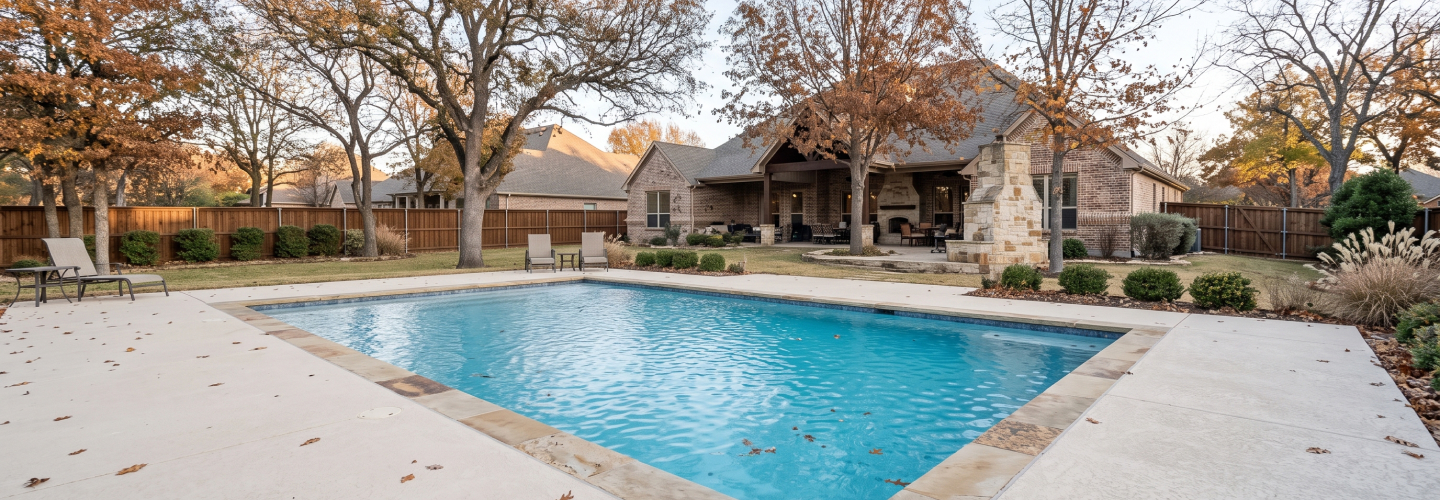

Poolie Team: Oct 22, 2026
For Texas homeowners who experience occasional freezes rather than months of freezing weather, keeping a pool operational with proper protection may make more sense than a full seasonal pool closure. But that choice depends on your local weather, equipment, and ability to keep up with maintenance.
This guide breaks down what Texas pool owners actually need to know about pool closure versus winter pool maintenance, and why you might need a different approach.
Pool Closure vs. Winter Pool Maintenance in Texas
A seasonal pool closure usually means preparing the water, winterizing the plumbing and equipment, and securing a suitable cover. It does not normally mean draining the entire pool. Winter maintenance keeps the circulation system operating while you continue cleaning, testing the water, and preparing for freezes.
Texas weather varies by location. The National Weather Service describes winter in the Rio Grande Valley as relatively gentle, but even that area can experience hard freezes. Your decision should account for how cold it gets where you live, how long freezing conditions last, and whether someone can monitor the pool.
Keeping your pool operational can be practical if you’ll continue using it or want to maintain it through the off-season. You’ll still pay for electricity, chemicals, and routine care, so compare those ongoing costs with the cost of closing and reopening your pool. Neither option is automatically cheaper for every homeowner.
The core difference is how you protect the plumbing and equipment. A properly closed pool has those components winterized for shutdown. An operational pool relies on continued circulation, suitable freeze-protection settings, and a backup plan if power fails. Circulation can reduce freeze risk, but it cannot guarantee protection during prolonged or severe cold.
When Keeping a Pool Operational Makes More Sense Than Closing It
Keeping your pool operational may make more sense if freezes are usually brief, your equipment has suitable freeze protection, and you or your pool service can monitor it throughout winter. You’ll also need a plan for power outages.
During freezing weather, follow the instructions for your specific pump, controller, heater, and other equipment rather than relying on a universal runtime or temperature setting. Some automation systems can turn circulation equipment on automatically when an air-temperature sensor reaches a programmed threshold, but the trigger temperature and protected circuits vary by system.
Algae can become a problem with either approach if water care slips. Closing a pool does not automatically cause algae, and keeping it running does not eliminate the risk. Proper preparation and continued checks help prevent you from uncovering, or looking out at, a green pool in spring.
Keeping your pool uncovered and in good shape means it’s available on those 65°F January afternoons when the kids want to be outside, or even for a cool dip during an unusually warm February weekend. That’s a benefit you give up entirely when you do a full pool closure.
When a Full Pool Closure May Make More Sense
A full seasonal closure is worth discussing with a pool professional if your area experiences extended freezes, your equipment cannot reliably maintain circulation, or you’ll be away without anyone checking the pool. It may also suit homeowners who won’t use the pool and prefer to have the system professionally winterized.
Closure still requires preparation and periodic checks. The decision comes down to which approach you can maintain reliably through your local winter, not simply whether you live in Texas.
Essential Rules for Safe Pool Maintenance During Winter Months
There are essential rules for safe pool maintenance during winter months, but they require specific adjustments to your chemical routine, equipment settings, and emergency plan.
Automated Freeze Protection Controls
If your pool has an automation system or pump with freeze-protection features, confirm that the appropriate settings are enabled before cold weather arrives. Do not assume every automatic controller protects every pump, valve, cleaner, heater, or water feature.
For example, some Pentair automation systems activate the filter pump when the air sensor approaches freezing, while other pump-level freeze features are specifically intended to protect the pump and may not protect all of the system plumbing. (Pentair freeze-protection guidance)
If your system does not have automatic freeze protection, or if the feature fails, use the manual operating procedure recommended by your equipment manufacturer or pool professional. The goal during a freeze is generally to maintain appropriate circulation through vulnerable plumbing, not to rely on a normal everyday timer schedule.
Do not use a blanket rule such as “turn the pump on at the breaker and leave it running until the temperature reaches 40°F.” The correct procedure and shutoff point depend on the equipment, controller, plumbing configuration, and actual weather conditions.
Off-Season Chemical and Filtration Adjustments
Your pool will not require as much attention during the winter months. Cooler water can slow algae growth and reduce some chemical demand, but that does not mean every pool can automatically cut its circulation time or testing frequency in half.
Pump runtime should be based on circulation needs, equipment requirements, water temperature, debris load, sanitizer system, and pump speed. A variable-speed pump operating at a lower speed, for example, may need a different runtime than a single-speed pump. During freezing weather, freeze-protection requirements take priority over an ordinary reduced winter schedule.
The same applies to water testing. There is no universal rule that every residential pool should be tested only once every two weeks in winter. Test often enough to keep sanitizer and pH within the ranges appropriate for your pool, and test sooner after heavy rain, significant refill water, large debris loads, or unusual weather.
The CDC recommends keeping residential pool pH between 7.0 and 7.8 and maintaining at least 1 ppm free chlorine in pools without cyanuric acid, or at least 2 ppm when cyanuric acid or stabilized chlorine is used. Those are public-health minimums, not a universal prescription that every pool should remain at exactly 2–3 ppm all winter. (CDC residential pool testing guidance)
Your pool finish, sanitizer system, equipment manufacturer, cyanuric-acid level, and other water-balance targets may call for narrower operating ranges.
For this season, you should still empty your skimmer basket. All those oak and pecan leaves will be falling in your pool, so empty your skimmer as often as needed to prevent debris from restricting flow. During heavy leaf drop, that may be more often than once or twice a week.
Emergency Protocols for Power Failures During a Texas Freeze
This is the scenario that causes the most expensive damage, and it’s also one that deserves a plan before temperatures fall.
If you lose power during a hard freeze, your pump stops, and water that was moving starts to sit. In a sustained freeze, water trapped in exposed plumbing or equipment can freeze, expand, and damage components.
What you should do next depends on your equipment and plumbing layout. Do not use a generic drain-plug checklist unless it matches the manufacturer’s winterizing procedure for your system.
Some pump manufacturers instruct owners to drain water from the pump and associated plumbing when freezing conditions are expected and circulation cannot be maintained. Pentair, for example, instructs owners of certain pumps to drain the pump and piping as part of winterization. (Pentair pump winterizing instructions)
A power-outage plan may include steps such as:
- Shutting off power to affected pool equipment before opening or draining components
- Draining the pump according to its manufacturer’s instructions
- Draining filters, heaters, chlorinators, and other equipment only according to their specific winterizing instructions
- Opening appropriate valves or plugs where instructed so trapped water can drain
- Leaving removed drain plugs in a safe location so the system is not restarted before it is properly reassembled
Do not assume every heater has the same number or location of drain plugs, or that every equipment pad can be protected by the same procedure.
If you are not already familiar with the winterizing procedure for your system, have a pool professional show you what to do before the first freeze rather than trying to learn it during a power outage.
FAQ: Common Texas Winter Pool Questions
1) Is it better to do a complete pool closure or stick to winter maintenance in Texas?
Winter pool maintenance may be practical where freezes are brief and someone can monitor the pool. A full closure may be more suitable where freezing conditions last longer or ongoing care is difficult. Consider your local weather, equipment, and availability before deciding.
There is no single answer for all of Texas. A homeowner in South Texas may face very different winter conditions from someone in North Texas or an exposed rural property.
2) Does running my pool pump all night during a freeze waste too much electricity?
Running the pump during a freeze uses electricity, but it can help reduce the risk of equipment damage. The cost depends on your pump’s power use, runtime, and electricity rate. Follow the recommended freeze settings for your equipment rather than reducing circulation simply to save power.
Freeze damage can cost considerably more than the electricity required for temporary protective circulation, but circulation is not a guarantee against damage if temperatures are severe, flow is restricted, equipment loses power, or portions of the plumbing are not being circulated.
3) How do I adjust my chemical testing schedule when switching to winter pool maintenance?
Base your testing schedule on pool use, weather, and water stability rather than the season alone. Ask your pool professional about an appropriate off-season schedule, and test sooner after heavy rain, substantial debris, or visible changes. Check the water before swimming, even if it looks clear.
If the pool remains available for swimming, keep sanitizer and pH within appropriate operating ranges regardless of the season.
4) What should I do if a freeze is forecast but my pool’s automated freeze protection fails to turn on?
Use the pump or controller’s manual operating mode according to the manufacturer’s instructions, and confirm that water is circulating. Check that the normal timer will not interrupt operation. If the pump won’t start or flow is blocked, contact a pool professional promptly.
While you’re at it, check your skimmer baskets before the freeze. Heavy leaf load from Texas oak and pecan trees can clog a skimmer basket so thoroughly that water can’t flow through the system even with the pump running. Clear the baskets before temperatures drop so debris does not restrict circulation.
Also verify that valves are positioned correctly for the equipment and plumbing you are trying to protect. On pools with spas, waterfalls, cleaners, or other auxiliary plumbing, freeze protection may need to account for more than the main pool circulation loop.
5) Does freeze protection still work if the power goes out?
No. Standard pool automation and pump freeze-protection features depend on electrical power. If the property loses power, the pump cannot keep water moving unless the system has an appropriately designed backup power source.
That is why an operational pool still needs a power-outage plan. Know in advance whether your equipment should be drained, which components need attention, and who you will call if power cannot be restored during a prolonged freeze.
Choosing the Right Winter Plan for Your Texas Pool
The gap between a pool closure and winter pool maintenance comes down to what your climate actually demands. For many Texas homeowners, keeping the pool operational through winter can be practical because prolonged freezing weather is less common than in colder parts of the country. But it is not “almost always” the safer or smarter choice.
Your decision should account for local freeze frequency and duration, equipment design, automation, plumbing exposure, travel plans, power reliability, and whether someone can respond if conditions change.
Small consistent habits, like checking freeze protection settings before the first cold front, clearing skimmer baskets during leaf season, and knowing your manual backup plan, protect equipment that costs serious money to repair or replace.
A pool that’s well taken care of through the winter season is a pool that is generally easier to bring into heavier spring use. Good winter care can reduce the likelihood of algae, staining, water-balance problems, and freeze-related equipment damage, but it cannot guarantee you will never need shock treatment, surface work, or plumbing repairs.
The goal is balanced water and a system that’s ready to go when the weather warms back up.
If you’d rather have a professional handle the seasonal adjustments, Poolie’s team can help Texas homeowners prepare their pools for cooler weather and freezing conditions. Review our guide to winterization or fill out the form below to discuss the right winter-maintenance plan for your pool.


