

Poolie Team: Oct 08, 2026
Scale on your waterline tile and etched plaster can be signs of a water-balance problem. Your pool’s Langelier Saturation Index (LSI) helps explain whether the water is more likely to form calcium scale or dissolve calcium carbonate from cement-based finishes. You may be checking pH and chlorine each week and still notice rough walls or cloudy water. The issue may be a missing piece of the picture: how temperature, calcium hardness, and alkalinity work together.
By the end of this guide, you will know how to calculate your LSI pool score, identify which variable is most likely pushing it off target as Texas temperatures drop, and adjust your water balance as conditions change.
What Is the Langelier Saturation Index (LSI) Pool Score?
The Langelier Saturation Index estimates whether your pool water tends to deposit calcium carbonate or dissolve it. Modern pool-industry versions of the calculation consider pH, calcium hardness, carbonate alkalinity, water temperature, and total dissolved solids. Cyanuric acid matters because it contributes to measured total alkalinity and may need to be accounted for when estimating carbonate alkalinity.
Why the ideal LSI pool target range is -0.3 to +0.3
An LSI of 0 represents calcium-carbonate equilibrium, but a pool does not need to remain at exactly 0.00 at all times. In the pool industry, a range around zero is commonly used as an operating target. The exact acceptable range can vary somewhat by reference, equipment manufacturer, and calculation method.
- Above the target range: Your water has a greater tendency to form calcium-carbonate scale. The higher the LSI rises, the stronger that scale-forming tendency becomes.
- Below the target range: Your water has a greater tendency to dissolve calcium carbonate from cementitious surfaces such as plaster and grout. This is often described as aggressive or corrosive water, although LSI specifically predicts calcium-carbonate saturation rather than every form of metal corrosion.
- Near zero and within the recommended operating range: The water is less likely to either deposit calcium-carbonate scale or dissolve it from cement-based surfaces.
The target is commonly around -0.3 to +0.3 in pool-industry guidance, with 0.0 as the ideal center. Check the recommendations for your pool finish, equipment, and the calculator or manufacturer you are using, since some references use a slightly wider acceptable range.
LSI vs. pH: Why pH alone doesn’t tell the whole story in cold weather
A pH reading of 7.4 doesn’t tell you everything about your water balance. Temperature, calcium hardness, and alkalinity also affect LSI. At 55°F, water can have a lower LSI than it does at 82°F, even when the other readings stay the same. That’s why checking pH alone can miss an increased tendency for calcium carbonate to dissolve from cement-based surfaces as the water cools.
How Autumn Shifts the Temperature of Water in a Swimming Pool
Autumn shifts swimming pool water temperature, and it has something to do with your LSI. As water gets colder, calcium carbonate becomes more soluble. If the other chemistry readings stay the same, a drop in temperature lowers the LSI.
That does not mean cold water suddenly becomes “hungry” for calcium overnight. Instead, temperature is one part of the saturation calculation. A pool already near the low end of its target range can move further negative as the water cools, which may increase the tendency to dissolve calcium carbonate from cement-based finishes.
Balancing the best swimming pool water temperature vs. fall realities
The EPA’s guidance for commercial pools notes that most heated pools are kept between 78°F and 82°F. But a comfortable swimming temperature doesn’t automatically guarantee balanced chemistry. Your pH, alkalinity, and calcium hardness still need to work together to keep your LSI within its target range.
As Texas temperatures drop, an unheated pool may fall below that comfortable swimming range. Cooler water allows more calcium carbonate to dissolve, lowering your LSI when the other readings stay the same. That means your summer water chemistry routine may need adjusting, even if your pH still looks fine.
You don’t have to heat the pool just to maintain its balance. Instead, measure the actual water temperature and use it alongside your current test results to recalculate LSI. Whether you keep swimming or leave the pool unused through fall, adjusting to the water’s actual conditions helps reduce the risk of plaster etching.
Fall Myth Buster: Does pool water evaporate more in cold weather?
Evaporation can continue during cool weather, particularly when the pool water is warm and the air is dry and windy. The EPA’s WaterSense guide explains that pool evaporation depends on temperature, humidity, and wind speed. Cold weather alone doesn’t tell you how much water your pool will lose.
Evaporation leaves dissolved calcium behind. Topping off with mineral-containing tap water can gradually increase calcium hardness rather than lower it. Water lost through leaks, backwashing, or draining behaves differently because it carries dissolved minerals out of the pool. Test your pool and fill water to understand how refilling affects the balance.
The Hidden Risks of an Imbalanced LSI Pool Rating
Water-balance problems often develop gradually rather than appearing all at once. Tracking LSI can help identify conditions that favor calcium-carbonate scaling or dissolution before visible symptoms become severe.
Plaster etching and grout damage (The corrosive risk)
Etched plaster has a certain feel to it. It’s rough or uneven when you walk on it. It may also develop a dull or chalky appearance. When water remains undersaturated with calcium carbonate, it can contribute to loss of calcium-containing material from cement-based finishes such as plaster and grout.
Persistently negative LSI conditions can contribute to etching of cementitious pool finishes. However, LSI does not explain every type of deterioration, and materials such as caulk do not behave the same way as plaster or grout. Once etching sets in, you cannot fix the lost material simply by rebalancing the water. Rebalancing can help stop conditions from continuing to favor dissolution, but it does not rebuild material that is already gone. A pool professional can assess the damage and determine whether localized treatment or pool resurfacing is needed.
Scaling and rough surfaces (The scaling risk)
When LSI rises above the recommended range, the water has an increasing tendency to deposit calcium carbonate. Scale often appears around waterline tile and other surfaces and can also form inside heaters, plumbing, and other equipment. In some cases, suspended calcium-carbonate particles may also contribute to cloudy water.
The right scale-removal method depends on where the deposit is located, how severe it is, and what surface is underneath it. Some deposits may respond to specialized scale treatments or professional cleaning. An acid wash is a much more aggressive procedure that removes a thin layer of cement-based pool finish and should not be presented as the routine solution for calcium scale. Sequestering agents can help control dissolved metals or mineral behavior in certain situations, but they do not simply remove every existing calcium deposit.
How tracking your LSI pool numbers protects your pump, heater, and equipment life
Your pool water passes through your pump, filter, heater, and connecting plumbing. Keeping that water balanced is part of protecting the equipment you rely on year-round. Pool equipment manufacturer Pentair explains that regularly checking and maintaining proper water chemistry helps reduce the risk of heater damage and corrosion.
Tracking LSI helps you identify conditions that favor calcium scale, which can build up inside equipment. But LSI alone doesn’t predict every type of corrosion or wear. Your pH, sanitizer levels, and equipment manufacturer’s water-quality requirements still matter.
Through fall, check LSI alongside your regular water tests and account for changes in water temperature. Catching an imbalance early gives you a chance to correct it before it contributes to buildup or costly repairs.
Water testing is one part of pool heater maintenance, alongside checking for leaks, corrosion, and changes in performance.
How to Calculate and Adjust Your LSI Pool Parameters
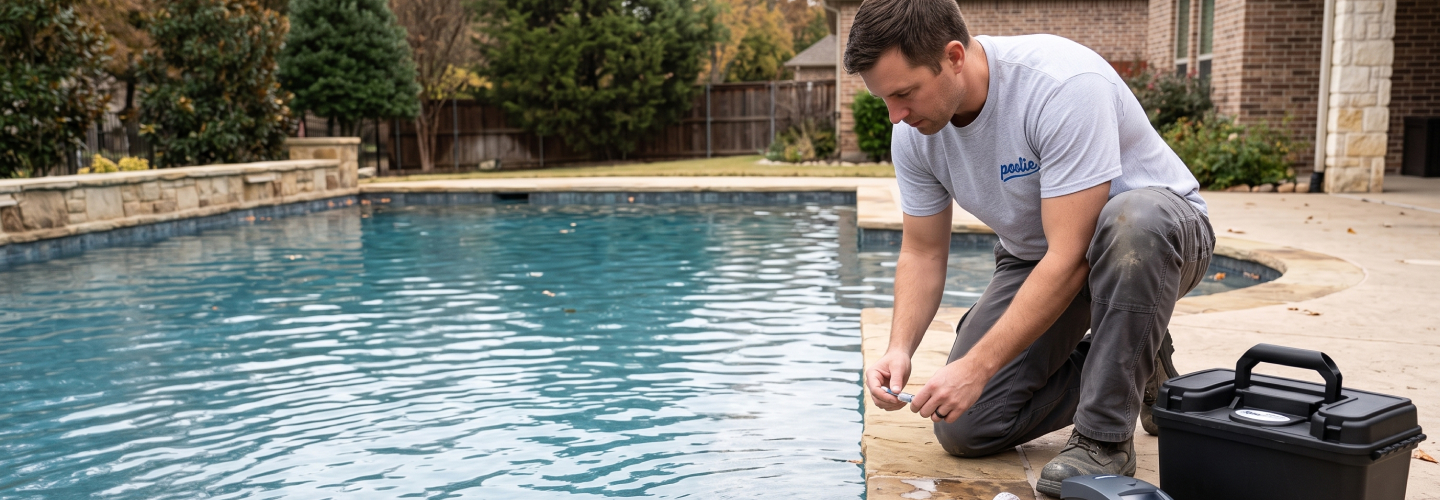
You don’t need to calculate LSI by hand. A pool-specific calculator can handle the calculation, but reliable pool water testing comes first. Accurate inputs make the result more useful.
Step 1: Measure pH, total alkalinity, calcium hardness, water temperature, CYA, and TDS using suitable testing equipment.
Step 2: Enter the results into a pool LSI calculator that accounts for CYA and TDS. Follow its instructions for any additional inputs, such as borates.
Step 3: Compare the result with the recommended target range, commonly -0.3 to +0.3.
Step 4: Review the individual readings and your pool’s surface and equipment requirements before choosing an adjustment. Don’t change a parameter simply because it isn’t at the midpoint of a general range.
Step 5: Follow the chemical label’s dosing and circulation instructions, then retest and recalculate before making further adjustments.
Which test method gives you a reliable input
Accurate readings make your LSI calculation more useful. For routine chlorine and pH testing, the CDC recommends a DPD test kit and notes that test strips are less accurate. You’ll also need suitable tests for the other LSI inputs, including calcium hardness, alkalinity, and CYA. Follow each test’s instructions carefully, and make sure your hardness result measures calcium hardness rather than total hardness.
Consistency matters when tracking trends, but there is no universal rule that pool water must be tested at the end of each day. Follow your test-kit instructions and test under reasonably consistent conditions when comparing one reading with another.
Outdoor pools can experience some pH variation from biological activity and carbon-dioxide exchange, but the original explanation had the chemistry reversed: carbon-dioxide outgassing tends to raise pH, while photosynthesis also consumes carbon dioxide and can raise pH. In a properly maintained pool with minimal algae, these effects should not be used as the main reason to choose a particular testing time.
Adjusting one variable at a time
Water-balance adjustments should be planned rather than made from a rigid “one variable at a time” rule. pH and total alkalinity are related, so changing one can influence the other. The amount of acid required to lower pH also depends partly on alkalinity.
Follow the chemical manufacturer’s dosing, circulation, and retesting instructions, and avoid stacking multiple large chemical adjustments without allowing adequate mixing time. If several readings are significantly out of range, a pool professional can help determine the safest order of correction.
Managing Your LSI Balance Even If Pool Water Evaporates More in Cold Weather
Even a closed or rarely used pool needs active management through fall. How often you need to test depends on weather, pool type, sanitizer system, cover use, debris load, and how quickly your chemistry normally changes.
- Monitor water temperature. Temperature is an important LSI input, and tracking it tells you when cooling may shift the saturation balance.
- Continue testing the chemistry on a schedule appropriate for your pool. Do not rely on an arbitrary two-week minimum if sanitizer, pH, or other parameters require more frequent attention. The CDC, for example, recommends testing residential pool chlorine and pH at least twice daily during active use.
- Do not automatically boost calcium hardness simply because the water temperature approaches 65°F. Calcium hardness should be kept within the range recommended for the pool surface and equipment, and any adjustment should be based on the complete water balance rather than temperature alone. Pentair, for example, lists 200 to 400 ppm as a recommended range in current salt-chlorinator guidance.
- Keep debris out of the water. Leaves and organic debris increase sanitizer demand as they break down and can contribute to staining or other water-quality problems.
- Test after significant refill or dilution events when appropriate. Fresh fill water may raise or lower calcium hardness, alkalinity, TDS, and other parameters depending on the chemistry of the source water.
- Do not intentionally push LSI to +0.1 or +0.2 simply because a freeze is forecast. A freeze-protection plan should focus first on protecting exposed plumbing and equipment from freezing, while water-chemistry adjustments should be based on actual test results and the pool’s recommended operating ranges.
Frequently Asked Questions About the LSI Pool
What is a digital LSI pool calculator and why should I use one?
A digital LSI calculator combines your water-test results to estimate calcium-carbonate balance. It reduces manual calculation errors, but the result still depends on accurate readings and correct inputs.
What happens to my pool equipment if I ignore an LSI pool imbalance all winter?
Poor water chemistry can contribute to equipment damage over time, but LSI alone cannot predict that a particular heater, pump seal, or filter will fail. Scale-forming water can contribute to mineral buildup in heaters and plumbing, while improper pH, sanitizer levels, and other chemistry conditions can contribute to corrosion or shortened equipment life.
Heater manufacturers typically specify acceptable water-chemistry ranges for this reason. Follow the requirements for your particular equipment rather than assuming a negative LSI automatically causes a specific failure such as a cracked filter tank or pump-seal rebuild.
Is LSI pool maintenance different for saltwater pools vs. traditional chlorine pools?
The same calcium-carbonate saturation principles apply to both saltwater and traditionally chlorinated pools, although the calculator should account for the higher TDS or salt concentration where applicable. Salt chlorine generators can also contribute to localized high pH at the cell and many salt pools tend to experience upward pH drift, which makes regular monitoring important.
A cold front does not make a pool scale faster simply because it is saltwater. Cooling the water lowers LSI when the other variables remain constant, which moves the water away from scale-forming conditions and toward greater calcium-carbonate solubility. If pH is rising at the same time, the final LSI depends on the combined effect of all the inputs.
How often should I check my LSI pool score during a winter pool closing?
There is no universal rule that every Texas pool should calculate LSI every two weeks or every ten days. Testing frequency should reflect the pool’s chemistry, sanitizer system, weather, cover status, fill-water characteristics, and equipment requirements.
LSI can be recalculated whenever meaningful changes occur in temperature, pH, alkalinity, calcium hardness, or TDS. Continue monitoring sanitizer and pH at the frequency appropriate for the pool even when swimming activity drops.
Keep Your Water Balanced Without the Hassle
Cooler water can quietly change your calcium-carbonate balance even when pH appears normal. Because temperature is part of the saturation calculation, a pool that was well balanced during summer may need a different chemistry strategy once fall temperatures arrive.
LSI is a useful tool for understanding calcium-carbonate scaling and dissolution, but it is not the only number that matters. Sanitizer level, pH, alkalinity, calcium hardness, CYA, salt or TDS, equipment requirements, and the condition of the pool surface all deserve attention.
Tracking those factors together and making measured adjustments can help reduce the likelihood of scale, etching, and avoidable equipment problems through the cooler months.
If you’d rather leave the testing and balancing to a professional, explore Poolie’s weekly pool maintenance service. Contact Poolie to discuss your pool’s care needs, or fill out the form below.


