

Poolie Team: Oct 14, 2026
You may think summer heat, hard water, and installation issues are to blame for pool plaster stains. But if you’re in Texas, fall deserves attention too. Cooler water can shift your pool’s chemical balance, while falling leaves add another source of discoloration. If you’ve recently replastered, proper startup care also matters as temperatures change.
This article will help you tell pool plaster stains apart from scale and surface damage, understand your cleaning options, and spot problems that need attention before winter.
The Science of ‘Hungry’ Water: How Temperature Changes Plaster
Water temperature affects the Langelier Saturation Index (LSI), a calculation that indicates whether water tends to dissolve or deposit calcium carbonate. With other readings unchanged, cooler water lowers the LSI. That means water balanced at 85°F in July may need a fresh check when temperatures drop in fall.
You may notice that your pool’s surface is starting to feel a little rougher than normal, especially around the steps and shallower areas. Etching happens when calcium-carbonate-undersaturated or otherwise aggressive water dissolves components of the plaster, leaving the surface rough or pitted.
A negative LSI means water is undersaturated with calcium carbonate; a positive value means it is oversaturated. A negative reading does not automatically mean the water is acidic. Read the LSI alongside your pH and other test results, using the range recommended for your pool finish.
How Dropping Temperatures Trigger Deep Pool Plaster Stains
Once your water begins to etch your pool plaster, it will leave your surface rough and pitted. That damaged texture can be harder to keep clean and may make discoloration or deposits more noticeable, but roughness itself does not automatically “attract” every contaminant or make staining permanent.
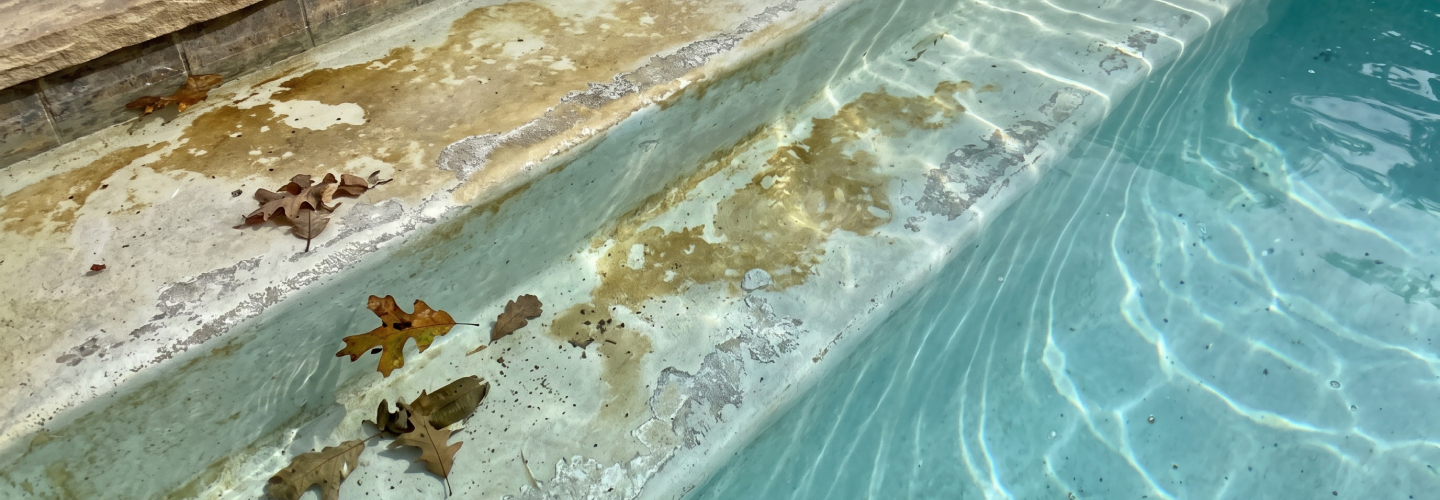
As the leaves begin to fall, your pool will accumulate more organic matter if debris is not removed promptly. Leaves and other plant material can release tannins and contribute to brown or yellow discoloration.
Metals in the water can also contribute to staining when they oxidize or precipitate. Iron is commonly associated with reddish, orange, or brown staining, manganese with darker brown or black staining, and copper can contribute to blue-green discoloration under some conditions.
According to the Water Quality Association, discoloration results from the exposure of metals like iron, copper, and manganese to oxygen, and staining can occur at concentrations as low as 0.3 ppm of iron or 0.05 ppm of manganese. The University of Nebraska-Lincoln Extension also notes that elevated iron and manganese levels produce reddish-brown and brownish-black staining on surfaces. Those thresholds come from drinking-water guidance and are useful evidence that very small metal concentrations can produce visible staining, but they should not be treated as pool-specific stain thresholds.
Etched plaster can make some discoloration more difficult to remove because the surface itself has been altered, but whether a stain can be removed depends on the cause, depth, and finish condition.
What may look like a stain in the fall could be a plaster problem in the spring.
Diagnosing Your Surface: Scaling, Etching, or Staining?
A rough or discolored pool surface can have several different causes, including calcium scale, etching, staining, or deterioration of the finish itself. Identifying the cause matters because the correct treatment is different for each one.
If your pool has calcium scale, your surface will look whitish or gray. Calcium scale often feels rough and appears around the waterline or pool fixtures. Scale can leave the surface rough and harder to clean.
Once the deposits are addressed, preventing calcium buildup can help keep the surface smoother and easier to clean.
If you’re dealing with etching on your plaster, you will feel that it has become rough, and you may see some areas appear chalky. Etching can leave your surface feeling very similar to sandpaper. This happens when aggressive water dissolves material from the plaster.
Your pool may simply have plaster stains. If you notice spots of brown, yellow, or black discoloration, your pool may be stained. Stains commonly come from organic debris or metals in the water. Because roughness and discoloration can have different causes, avoid choosing a treatment based on appearance alone.
Correcting the chemistry can help prevent further etching, but it won’t restore plaster that has already worn away. Scale and stains need treatments matched to the deposit, stain, and finish. Identify the problem before adding chemicals.
Tips for Identifying and Cleaning Pool Plaster Stains Safely
Before cleaning pool plaster stains, remove loose debris, check your water chemistry, and identify the likely cause. Use a stain-identification product approved for your finish, following its directions, or have a pool professional assess the area.
For suspected organic stains: Remove leaves and debris, then brush with a brush approved for your finish. If discoloration remains, choose a treatment intended for organic stains and follow the product’s directions. Don’t place granular chlorine directly on the plaster unless the pool-finish and chemical manufacturers specifically direct that treatment.
For suspected metal stains: Have the stain assessed before adding more chemicals. A stain treatment may improve the discoloration without resolving the source of the metals, so ask how to prevent the problem from returning.
For suspected scale: Don’t pour muriatic acid directly onto the surface as a test. Have the deposit identified and choose a removal method suited to your finish.
Avoid aggressive scrubbing or repeated chemical treatments when the cause is unclear. If the plaster is new, check with your installer before attempting stain removal.
When Pool Plaster Stains Need More Than Cleaning
Persistent discoloration deserves a closer look when it appears alongside roughness, flaking, or other surface wear. Before scheduling replastering, have the surface assessed to see whether cleaning, a localized repair, or resurfacing makes sense. Fall can be a practical time for the work, depending on local conditions and your contractor’s schedule.
How Cold Overnight Lows Affect Fresh Plaster Curing
The first several weeks after a new plaster installation are especially important. National Plasterers Council startup guidance uses a 28-day startup period during which water chemistry, brushing, circulation, and other care requirements should be closely managed.
Cool weather can slow cement hydration and curing, but there is not a universal rule that pool plaster stops curing correctly whenever pool water falls below 50°F. The appropriate temperature limits and cold-weather precautions depend on the specific finish, manufacturer, installation conditions, and contractor procedures.
Likewise, a single overnight drop in outdoor temperature does not automatically cause properly applied pool plaster to crack. Cracking or crazing can be influenced by several factors, including mix design, substrate condition, application technique, moisture loss, shrinkage, temperature, wind, and curing conditions.
Concrete guidance does show that lower temperatures slow cement hydration and strength development, but pool plaster is a specialized cementitious finish, so general concrete guidance should not be converted into a universal 50°F pool-water cutoff.
If you hire a professional for a fall plaster project, ask what temperature and weather limits apply to the specific finish being installed and how the crew will manage fill, startup, and curing if temperatures change. Follow the finish manufacturer’s and installer’s requirements rather than relying on one temperature threshold.
When a Spot Patch Is Enough vs. Getting a Full Resurface
If you want to spot patch some areas of your pool, you will most likely have trouble trying to match the color. Once it starts to age, the color of your pool will change, and if you add new plaster, it will most likely be lighter than your current pool surface. You may not see the difference if the spots you’re patching aren’t too noticeable.
Whether a spot repair or full resurface makes sense depends on the cause, depth, location, bond of the existing finish, and how widespread the damage is. There is no industry-wide rule that says a pool must be resurfaced once 20% or 25% of the plaster is stained.
Localized stains or isolated surface defects may sometimes be treated or repaired without resurfacing the entire pool. Widespread etching, delamination, spalling, soft or deteriorating plaster, or extensive bond failure can make full resurfacing the more appropriate option.
If pieces of the finish are loose, flaking, or easily separating from the substrate, have the pool professionally assessed rather than relying on a percentage-of-surface rule.
Proactive Maintenance: Keeping Your Chemistry Balanced All Winter
Keeping your water chemistry balanced through fall and winter helps protect the plaster from etching. Base adjustments on current test results instead of automatically raising chemical levels when temperatures drop.
Manage calcium hardness as part of the full water balance. Do not automatically raise calcium hardness to 250–350 ppm simply because the weather is cooler. The appropriate range depends on the pool finish, equipment, fill water, and manufacturer guidance. The National Plasterers Council advises avoiding low-calcium fill water and notes that traditional cementitious finishes generally should not be filled with water below about 200 ppm calcium hardness, with some high-performance finishes allowing lower levels.
The better goal is to keep the overall saturation balance appropriate as temperature changes rather than chasing one fixed winter calcium target.
Manage total alkalinity together with pH and the other LSI inputs. Alkalinity helps buffer changes in pH, but there is no universal recommendation to raise every pool to 100–120 ppm during cold weather. The appropriate alkalinity range depends on factors such as sanitizer type, CYA, borates, finish, and equipment.
Keep testing even when the pool is closed or covered. A covered pool still undergoes chemical changes. The effect of a cover on pH and carbon dioxide depends on the cover type, circulation, chemistry, and environmental conditions, so do not assume every covered pool will accumulate carbon dioxide and experience falling pH.
Testing frequency should be based on the pool’s conditions and the finish or equipment manufacturer’s guidance. NPC technical guidance recommends testing pH, total alkalinity, and chlorine one to two times per week and calcium hardness, stabilizer, and TDS about monthly during normal operation. A newly plastered pool requires substantially closer monitoring during startup.
Poolie’s weekly maintenance service covers water chemistry testing and adjustment year-round, including through the fall and winter months when most pool owners are not paying close attention. Catching a water-balance problem early gives you a chance to address it before more surface damage develops. Repairing the plaster damage from ignoring it all winter is a significantly larger project.
Frequently Asked Questions
Can I negotiate a lower price on pool plaster installation if I schedule it during fall when demand is lower?
Fall scheduling and pricing vary by contractor, market, weather, and workload. Some companies may have more schedule flexibility during slower periods, but there is no industry rule that fall plaster work should cost less. Material, labor, preparation, finish choice, and project complexity still drive much of the price.
If timing is flexible, ask contractors whether seasonal scheduling affects their availability or pricing rather than assuming a discount will apply.
Is fall plaster damage covered under a pool contractor’s warranty?
Warranty coverage depends on the specific contractor and finish manufacturer. There is no universal rule that all workmanship-related plaster problems are covered or that all environmental damage is excluded.
Many plaster and aggregate-finish warranties distinguish between manufacturing or installation defects and problems associated with water chemistry, maintenance, staining, scaling, or owner-applied chemicals. Proper startup and documented water chemistry may also be conditions of coverage.
If you notice a problem, review your written warranty and contact the installer before attempting aggressive cleaning or repair. Determining the cause may require an inspection rather than relying on appearance alone.
How do I know if my plaster cracking was caused by fall weather versus poor installation?
You usually cannot determine the cause of plaster cracking from the pattern alone. Fine interconnected cracks, often called crazing or checking, occur within the cementitious finish and can be associated with factors such as rapid moisture loss, shrinkage, mix proportions, substrate absorption, finishing practices, or curing conditions.
Deeper cracks can involve movement or failure in the underlying pool shell, but direction or appearance alone is not enough to prove the cause. Ground movement, structural conditions, substrate preparation, bonding, and installation history may all need to be evaluated.
If new cracking appears shortly after plastering, document it with photographs and ask the installer to inspect it before assuming weather or workmanship is responsible.
Should I wait until spring to replaster if fall temperatures have already arrived?
Not necessarily. Fall replastering can be practical in Texas when weather and water conditions remain within the requirements of the finish manufacturer and installer.
Instead of using the arrival of fall or a particular calendar date as the deciding factor, ask the contractor about minimum application temperatures, forecast weather, fill procedures, startup requirements, and what happens if a cold front arrives during the project.
If conditions fall outside the finish manufacturer’s requirements or the contractor cannot reliably manage the installation and startup, postponing the work may be the better choice.
Are older pools more vulnerable to fall weather plaster damage?
Age alone does not make plaster suddenly more vulnerable when fall arrives. Older finishes are more likely to have accumulated wear, etching, staining, repairs, or other deterioration over time, which may make existing problems more noticeable.
Traditional white plaster often has a shorter expected service life than premium aggregate finishes, but actual lifespan varies widely with installation quality, water chemistry, maintenance, finish type, and environmental conditions. A 10-year-old finish is worth inspecting, but “over 10 years old” is not a universal failure threshold.
Focus on the condition of the finish rather than its age alone. Increasing roughness, delamination, persistent staining, pitting, spalling, or widespread deterioration are more useful reasons to seek an assessment.
Protect Your Investment Before the Temperature Drops
Fall doesn’t just mark the end of swim season. It brings changes in water temperature, debris load, and pool use that can expose or contribute to existing water-balance and surface problems.
If your plaster is showing new roughness, discoloration, pitting, flaking, or soft areas, start with a complete water test and a close look at the surface. Include pH, total alkalinity, calcium hardness, sanitizer level, CYA where applicable, temperature, and the other inputs needed to evaluate saturation balance.
Take photos so you can track whether the condition changes over time. If the problem is widespread, worsening, or difficult to identify, have the finish assessed before choosing a chemical treatment or assuming the pool needs to be resurfaced.
Contact Poolie or fill out the form below to discuss your pool’s water balance and surface condition and find out what to do next.


