

Poolie Team: Nov 11, 2026
Your freeze protection system is running. Your pump is cycling. You feel covered, and for much of your pool’s circulation system, you probably are. But there’s a small group of components sitting outside that circulating loop, and they’re the ones that can be overlooked when a Texas freeze hits. Pool autofill lines and backflow preventers are two parts most pool owners forget exist until cold weather exposes a problem.
Understanding how to protect pool pipes from freezing means covering all of your plumbing, not just the obvious parts. This article covers what makes those auxiliary lines so vulnerable, what happens when they freeze, and what you can do about it.
The Hidden Vulnerabilities: How to Protect Pool Pipes From Freezing
The key to knowing how to protect pool pipes from freezing is understanding that your pool’s plumbing isn’t one single system. It’s several. Your main filtration loop moves a large volume of water, and your freeze protection automation is designed to keep water circulating through that system. Your autofill supply line and backflow preventer, however, are part of a separate water-supply connection. Unless your system has dedicated freeze protection for these components, they may remain outside the protection provided by your main pool pump.
Smaller-diameter pipes can lose heat relatively quickly, especially when they’re exposed above ground or lack insulation. Your autofill supply line and backflow preventer also operate independently of the main circulation loop, so your pool’s freeze protection may not keep water moving through them. Because the autofill is connected to a pressurized water supply, these lines can remain full of water even when your pool pump is running.
The Autofill Line: Why It Gets Forgotten Until It Bursts
Your autofill line will run as needed to replenish your pool water that may have evaporated or splashed out of your pool. You may rarely notice when the float valve opens and closes, so when it comes to protecting your pool pipes from freezing, it can easily be overlooked.
Think of a garden hose left connected to the spigot all winter: pressurized, full of standing water, and exposed to the air. An exposed autofill supply line can face a similar problem. Water may remain in the line while temperatures fall, increasing the risk of freezing and damage if the plumbing is not adequately protected.
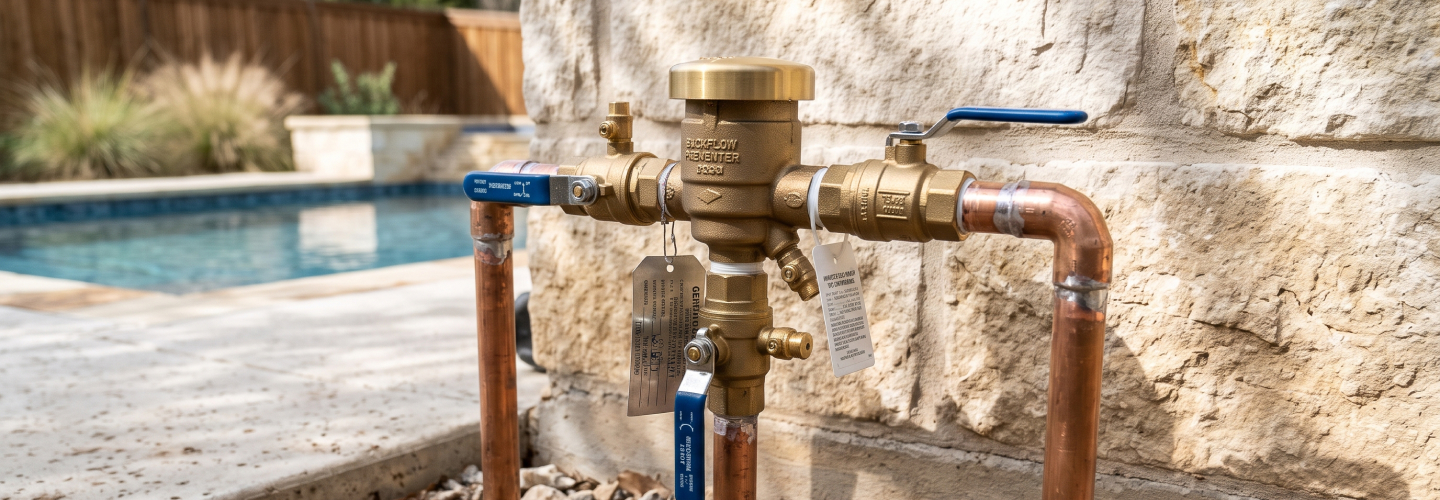
Backflow Preventers: Why Brass and Copper Valves Are the First to Crack
According to the EPA’s Cross-Connection Control Manual, backflow prevention devices are designed to stop unwanted reverse flow from entering a potable water system. If a backflow assembly is damaged, it may leak or no longer provide the cross-connection protection it was designed to provide.
Brass and copper conduct heat efficiently, which means exposed metal components can lose heat quickly in freezing conditions. However, the risk also depends on the assembly’s design, insulation, and exposure. When water freezes inside a backflow preventer, ice formation and pressure buildup can damage its internal components, fittings, or housing.
Manufacturers specifically warn about this risk. Watts states that backflow prevention assemblies can be damaged if internal water is allowed to freeze and recommends model-appropriate measures such as draining, insulation with approved heat protection, or a heated enclosure. (Watts freeze-protection instructions)
Because the assembly is connected to your home’s potable water supply, a failure can affect more than just your pool by causing a supply-side leak or compromising the backflow assembly until it is repaired and retested as required.
The Science of the Freeze: Why Your Main Pump Won’t Save These Pipes
When your freeze protection turns your pump on, it will keep water moving through your main lines. This can reduce freeze risk in the portions of the system receiving adequate circulation, although it does not guarantee protection during prolonged or severe freezing conditions.
Your autofill line isn’t normally part of that loop. When your freeze protection sensor kicks on and your main pump starts running, those auxiliary components may still contain stationary water because they are supplied independently from your home’s potable water system.
Moving Water vs. Static Water (Why Your Main Freeze Protection Leaves Auxiliary Lines Frozen)
Moving water can be less susceptible to freezing than water sitting in an exposed pipe, but movement does not prevent ice crystals from forming by “breaking their bonds.” Flow can continually introduce water from elsewhere in the system, change heat transfer, and reduce how long the same water remains exposed to the cold. It can also help relieve some pressure depending on the plumbing arrangement.
Even flowing water can freeze during sufficiently cold or prolonged conditions, which is why circulation should not be treated as a guarantee. Utah State University Extension specifically cautions that insulation alone may not protect plumbing through prolonged freezing conditions without heat or periodic water flow. USU freeze-protection guidance
The water sitting inside your autofill line has less of that protection if it remains stationary. And when water freezes, according to the University of Illinois Department of Physics, liquid water increases in volume by about 9%. In confined plumbing, freezing and the resulting pressure can damage pipes, valves, fittings, and other components.
Wind Chill and Exposed Plumbing Fittings
Wind chill doesn’t lower the temperature of water below what the air itself reads, but moving air can increase convective heat loss from exposed plumbing and cause it to approach the outdoor air temperature faster.
That makes wind exposure one of several factors to consider for an above-ground backflow preventer or supply line. The actual time it takes to freeze depends on air temperature, starting water temperature, pipe or valve design, insulation, wind, and how long the cold lasts.
Texas A&M specifically identifies exposed plumbing and swimming pool supply lines as vulnerable during freezes and recommends taking precautions whenever temperatures fall below freezing.
Hidden Destruction: What Happens When Auxiliary Lines Freeze?
When your auxiliary lines freeze, you may not discover the damage until the ice begins to thaw and water starts flowing again. Here are some things that you might see next:
Cracked Backflow Preventers and Hidden Underground Leaks
When a backflow preventer cracks, it doesn’t always announce itself. A freeze-damaged assembly may begin leaking once the water thaws and the supply is repressurized.
If the auxiliary line splits under the deck, it may leak underground and show up as persistently wet soil, unexpected water use, or another symptom of a plumbing leak. Diagnosing a buried failure may require leak detection and excavation.
Cracked Autofill Housings and Supply Plumbing
Some pools have an autofill assembly located near the pool edge or incorporated into the deck or skimmer-area construction. If water freezes inside an exposed or vulnerable autofill component, the housing, valve, fitting, or connected plumbing can be damaged.
The amount of demolition needed for a repair depends on where that component is installed. In some configurations, reaching a damaged autofill line or housing may require disturbing nearby deck, coping, tile, or landscaping.
I would not describe a frozen autofill as routinely creating “wall splits” in the structural pool shell. That is a much more serious structural claim and is not a normal or inevitable consequence of an autofill freeze.
Signs Your Auxiliary Pool Pipes Need Immediate Attention
Below are some warning signs to look for before cold weather arrives:
Visual Warning Signs: Calcium Scaling, Slow Drips, and Exposed Shifting Lines
If you notice calcium scaling around your backflow preventer or autofill valve, it can indicate that water has been evaporating or leaking in that area, but scaling by itself does not mean the pipe is beginning to crack.
Also look for any lines that may be sticking out of the ground. If your pipe is exposed to the elements, it will be more likely to freeze. If you see any dripping, wet soil, corrosion, or evidence of an active leak, have the source identified before the freeze.
How to Test Your Dedicated Shut-off Valve Before the Freeze Hits
Find your autofill isolation valve. If you know which valve it is and the manufacturer or installer permits normal homeowner operation, confirm ahead of the freeze that you can shut the autofill supply off without forcing the valve.
Do not operate test cocks, disassemble a backflow preventer, or attempt a backflow winterization procedure unless you know the correct procedure for that exact assembly. Backflow devices can require a specific sequence of shutoff-valve, drain, and test-cock positions to drain correctly.
When to Call a Poolie Professional for an Inspection
A visual inspection catches surface scaling, exposed lines, and obvious drips, but not a hairline crack in a buried line or a slow failure developing inside the backflow assembly.
Poolie uses pressure testing and other professional leak-detection methods when appropriate to evaluate suspected plumbing leaks, including problems that may be hidden below finished surfaces. (Poolie’s leak-detection guidance)
Pressure testing can determine whether an isolated plumbing section is losing pressure, although additional leak-detection methods may still be needed to pinpoint the exact location.
How to Safely Insulate Your Autofill and Backflow Lines
Once you’ve identified which lines are exposed or vulnerable, insulation may be one part of the freeze-protection plan. The right approach depends on the pipe, valve, backflow assembly, exposure, and expected duration of the freeze.
Will pool noodles keep pipes from freezing? Don’t rely on them as a substitute for purpose-made pipe insulation. Pool noodles are not manufactured or rated as plumbing freeze-protection products.
Use insulation or heat-protection products intended for plumbing and compatible with the component being protected. Texas A&M recommends pipe sleeves, insulation, or appropriately rated heat tape for vulnerable exposed water lines. Texas A&M freeze guidance
Backflow preventer manufacturers may have additional requirements. Watts, for example, lists proper draining, freeze insulation with appropriate heat protection, and heated enclosures as possible methods depending on the installation. Watts backflow winterization guidance
If your autofill system is designed with an isolation valve and a means of draining the vulnerable section, shutting off the supply and draining the line can reduce freeze risk because less trapped water remains available to freeze. Follow the installer or manufacturer’s procedure for your exact plumbing arrangement.
Do not assume the backflow preventer can be drained simply by closing the autofill valve. Many backflow assemblies have their own specific winterization procedure, and improper valve or test-cock positions can leave water trapped inside the device.
Once the system is returned to service after the freeze, inspect accessible components for leaks and make sure any backflow assembly that requires testing or service receives it from the appropriate qualified professional.
Frequently Asked Questions
1) How long does it take for pool pipes to freeze?
There’s no single timeline. Exposed pipes containing still water can begin freezing within hours during sustained freezing conditions, while insulated or buried lines may take longer. The actual time depends on the starting water temperature, pipe material and diameter, insulation, wind exposure, and how cold the air gets. Smaller exposed supply lines and backflow components deserve particular attention because they may have little protection from the cold.
2) Will freeze protection automation protect my autofill line?
Usually not through the main pool circulation system. Automated freeze protection typically works by monitoring ambient temperature and activating assigned pool equipment to circulate water through selected pool plumbing.
Your autofill line is a separate supply line fed by your home’s fresh water, so running the main circulation pump normally does not create flow through that supply line or its backflow assembly.
There are custom plumbing and control arrangements, so avoid saying automation has “no way” to protect an autofill in every possible installation. The key is to identify how your specific autofill and backflow assembly are protected.
If temperatures are forecast to drop below freezing, follow the freeze-protection instructions for the autofill plumbing and the specific backflow assembly. Depending on the installation, that may involve isolation, drainage, insulation, approved heat protection, or professional winterization.
Protect Your Entire Pool System with Poolie This Winter
The autofill line and backflow components sitting outside your filtration loop can be particularly easy to overlook because the main pool pump may not circulate water through them.
Knowing how to protect pool pipes from freezing means accounting for all of it, not just the main loop. Don’t wait for the thaw to find out something failed overnight.
If you spotted any warning signs, or if your auxiliary plumbing hasn’t been checked heading into this winter, the Poolie team is ready to help. Schedule your winterization check online today by filling out the form below, and make sure the overlooked parts of your pool plumbing are part of your freeze plan too.

