

Poolie Team: Sep 29, 2026
Pool coping stones do more than frame your pool’s edge. They’re exposed to sunlight, chemicals, and constant foot traffic that most homeowners don’t consider until something goes wrong. Choosing based on looks alone can backfire when bare feet hit a scorching stone in July or when salt water starts affecting a material that wasn’t suited for the environment.
This guide talks through how coping stones perform under real-world stress, so that you can choose the right material and edge profile to suit your pool’s footprint and daily use․
The Anatomy of a Pool Edge: Coping Stones vs. Decks
The anatomy of a pool edge starts with understanding that coping and pool decking are two separate components of the pool area, not one continuous surface.
The Bond Beam Cap
Coping rests directly on top of your pool’s bond beam, the reinforced concrete edge that forms the upper perimeter of the pool shell itself. It’s a distinct component of the pool structure, not simply an extension of the patio deck, so its installation has different structural and movement-joint considerations from the surrounding paving.
The Expansion Joint Factor
The coping and the deck can move differently with changes in temperature and other conditions. A flexible joint is typically left between the coping and surrounding deck material, such as concrete or pavers, to accommodate movement and help reduce cracking or other damage as temperatures change.
Head-to-Head Performance: Concrete, Natural Stone, and Tiles
Concrete, natural stone, and tile each have advantages and disadvantages when used as a pool edge, but none of them wins on every metric.
Concrete Pool Coping (Precast Pavers vs. Poured Concrete)
Concrete used in freeze-thaw exposure may be designed with entrained air, which creates microscopic air voids that give freezing water room to expand and can improve freeze-thaw durability. The National Ready Mixed Concrete Association explains the role of air entrainment in protecting concrete exposed to freezing and thawing conditions.
Poured and precast concrete can provide solid compressive strength and a dense, load-bearing pool edge when properly designed and installed. Its performance depends heavily on the concrete mix, finish, exposure, and maintenance. Concrete can withstand normal pool-water exposure, but concentrated chemicals or acid spills can damage cement-based surfaces, while heat retention varies with color, density, moisture, and sun exposure.
Natural Coping Stone Materials
Natural coping stone options each come from a different geological process, and that origin helps influence how they perform.
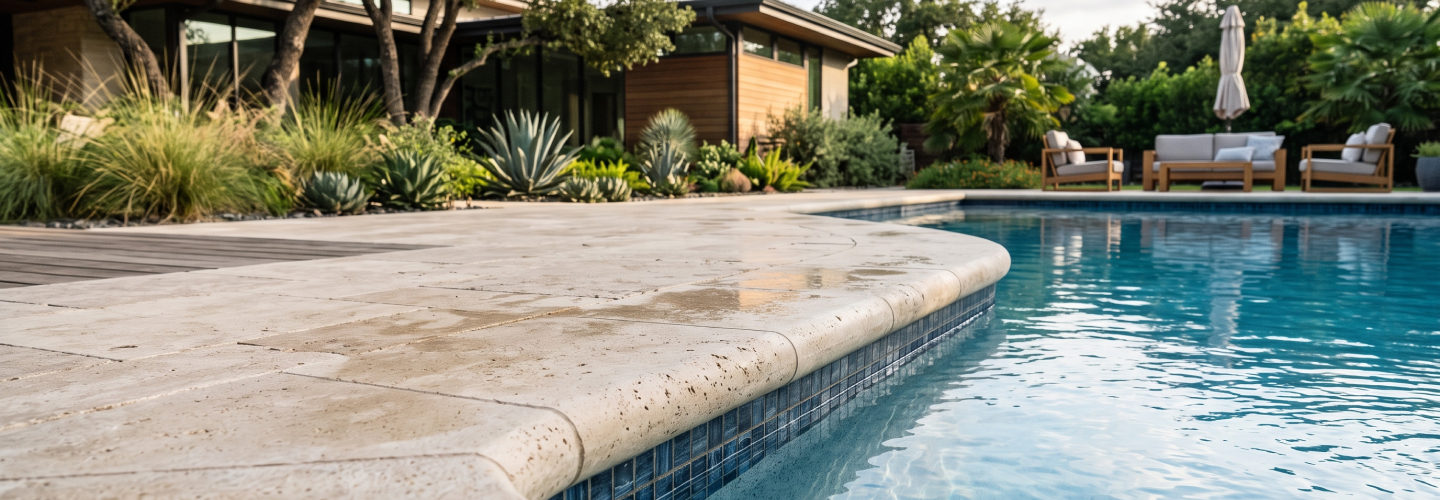
- Travertine is a porous sedimentary stone that tends to stay relatively cool underfoot, particularly in lighter colors. Tumbled or textured finishes can also provide good wet traction, although slip resistance depends on the specific finish and surface condition.
- Limestone is another natural stone whose performance can vary significantly by type, density, finish, and porosity.
- Granite is an igneous stone that is generally dense and durable. However, darker granite can become hot in direct sunlight, so color, finish, and site exposure matter when choosing it for pool coping.
High-Performance Pool Coping Tiles
Pool coping tiles made from porcelain or other products specifically manufactured for exterior pool applications bring a different set of strengths. Porcelain tile has very low water absorption, typically 0.5% or less under the ANSI definition, which can make properly rated porcelain products a strong option for exterior wet environments, including areas subject to freeze-thaw conditions. However, no material is completely immune to damage, and the tile’s installation, substrate, finish, and exposure still matter. Its dense surface also generally provides good stain resistance.
For poolside applications, choose a product specifically rated for exterior wet use and follow the manufacturer’s slip-resistance data. In the U.S., ANSI A326.3 distinguishes between interior wet and exterior wet applications; the current standard identifies exterior wet surfaces as a manufacturer-declared classification rather than applying the 0.42 wet DCOF threshold used for certain interior wet surfaces.
The Selection Matrix: Evaluating Critical Stone Metrics
The selection matrix below lines up the core performance metrics side by side, so you can compare materials at a glance before getting into the details that matter most for your pool.
Quick Comparison Matrix
| Material Type | Slip Resistance | Heat Exposure | Chemical/Salt Considerations | Maintenance Considerations |
| Precast Concrete | Varies by finish | Varies by color and finish | Can be affected by concentrated chemicals and some salts | May benefit from sealing depending on product and exposure |
| Travertine (Natural) | Often good with an appropriate textured finish | Often relatively cool, especially in lighter colors | Porosity can make salt and chemical exposure important considerations | May require sealing depending on stone and conditions |
| Granite (Natural) | Varies by finish | Darker colors can become hot | Generally durable, but performance varies by stone and exposure | Often relatively low maintenance when properly installed |
| Porcelain (Tile) | Depends on the product’s exterior-wet rating and surface texture | Varies by color and sun exposure | Very low water absorption and generally good stain resistance | Grout, joints, substrate, and installation still require maintenance |
Installed pricing and expected service life vary too widely by material quality, stone thickness, edge profile, fabrication, region, labor, substrate condition, and installation method to assign a reliable universal range. Ask your contractor for pricing and warranty information for the specific product being considered.
Durability and Chemical Resistance
Durability and chemical resistance depend on more than porosity alone. Material composition, density, finish, installation, water chemistry, maintenance, and environmental exposure can all play a role. Saltwater pools can leave salt deposits on porous surfaces, while improperly balanced or concentrated pool chemicals can contribute to surface deterioration. UV exposure can also fade some concrete pigments and surface finishes over time. Natural stone can weather and change in appearance as well, depending on its mineral composition and exposure.
Slip Resistance and Texture Mechanics
Slip resistance and texture are especially important around a pool, where surfaces are frequently wet. Tumbled, honed, flamed, and bush-hammered finishes have different textures and may perform differently under wet conditions. A surface that feels grippy when dry may perform differently when wet. Because wet slip resistance depends on the material, finish, texture, contaminants, drainage, maintenance, and test method, homeowners should rely on the manufacturer’s wet-slip testing or product-use classification rather than a hand-feel test.
Thermal Conductivity and Heat Exposure
A material’s thermal properties, color, density, moisture content, and exposure to sunlight all affect how hot it can feel underfoot. Light-colored, relatively porous stones such as travertine can feel cooler underfoot in direct sunlight than some darker, denser materials. Because actual surface temperatures vary with conditions, samples should ideally be evaluated in similar sun exposure before making a final choice.
Long-Term Maintenance and Sealing Requirements
Stone may require maintenance and sealing based on its density and porosity. A porous stone, such as some types of limestone, may benefit from a penetrating sealer, with reapplication based on the product manufacturer’s recommendations and the stone’s condition. Dense materials may absorb less water, but that does not make them maintenance-free. Surface texture also affects cleaning: rougher surfaces can trap dirt and debris, while smoother surfaces are generally easier to clean. Rough-textured concrete or stone may hold more debris in surface irregularities, while smoother tile surfaces are typically easier to wipe or rinse clean.
Edge Profiles and Surrounding Deck Integration
Edge profiles and surrounding deck integration determine how your coping physically meets both the water and the walking surface around it.
The Water-Line Interface
With a drop-face or rebated profile, the coping extends down over the waterline area, creating a defined transition between the coping and tile. A bullnose style rounds the edge and overhangs the tile for a softer, traditional look. Both are functional, and either one can be used depending on the pool design and the look you want.
The Deck Transition
The way coping meets your patio deck matters just as much as how it meets the water. A properly installed coping and deck transition should account for movement while also avoiding unnecessary changes in elevation that could create a trip hazard.
Tailoring Coping to Your Pool’s Specific Footprint
Tailoring coping to your pool’s specific footprint means matching the material to how the pool gets used rather than just how it appears in a photo․
For a high-traffic family pool, a rounded bullnose profile made from concrete or tumbled travertine can provide a comfortable edge, while the material and finish can offer good durability and wet traction when properly selected. A minimalist or modern lap pool may suit a sharp, drop-face porcelain profile, which creates clean geometric lines that complement a contemporary design.
When it comes to budget versus lifespan, it’s worth weighing the lower upfront cost of some concrete options against the potentially higher upfront cost of materials such as granite or porcelain. Rather than assuming one material will always deliver the best lifetime value, consider installation quality, maintenance requirements, local climate, warranty coverage, and the specific product’s expected performance.
Technical FAQs for Coping Stones
1) What type of stone is best for pool coping?
Travertine is a popular choice for pool coping and patio paving because it can stay relatively cool underfoot, provide good traction in appropriate finishes, and offer a natural appearance that works well around pools. Granite is another durable option, although darker colors can become hotter in direct sunlight. The best choice ultimately depends on climate, finish, maintenance expectations, pool chemistry, budget, and how the area will be used.
2) What is the standard size of pool coping?
Common coping pieces are often around 12 to 16 inches wide, but dimensions vary by material, manufacturer, edge profile, and pool design. Custom pieces may also be fabricated for curves, corners, steps, and unusual pool shapes.
3) What is the minimum thickness required for structural pool coping stones?
There isn’t one universal minimum thickness for every coping material or installation. Coping thickness varies by material, manufacturer, span, overhang, installation method, and structural requirements. Natural stone coping is commonly available in thicknesses around 1.25 to 2 inches, but the appropriate specification should come from the manufacturer and installer for the particular application.
4) Why is my natural stone coping, flaking or pitting near the water line?
This can sometimes be caused by salt crystallization, sometimes referred to as salt weathering or salt-related spalling. Water containing dissolved salts can enter the pores of some stone. As moisture evaporates, salts may crystallize within those pores. Repeated crystallization can place stress on susceptible stone and contribute to flaking, powdering, or other surface deterioration. Other causes, including material quality, water chemistry, installation, and environmental exposure, should also be considered.
5) Can you lay pool coping tiles directly over an existing concrete coping edge?
Potentially, if the existing concrete coping is structurally sound, properly prepared, and suitable for the intended tile installation. The surface should be free of significant cracks, delamination, movement, and other defects, and the installer should verify that the substrate and tile-setting system are appropriate for exterior wet conditions. Tiling over a compromised or moving substrate does not correct the underlying problem and can lead to cracking, debonding, or other installation failures.
Making Your Final Choice: The Perfect Edge for Your Pool
Choosing the right pool coping comes down to matching material performance to your climate, your pool’s daily use, and how much long-term maintenance you are willing to take on. Weigh heat exposure, slip resistance, and chemical compatibility against your budget and the appearance and long-term performance you want out of your investment.
Every backyard has different conditions to consider, so it’s worth consulting a qualified pool professional before finalizing your material choice. Poolie’s team can help you evaluate coping options based on your pool’s design, conditions, and intended use. Fill out the form to get started.


