

Poolie Team: Oct 13, 2026
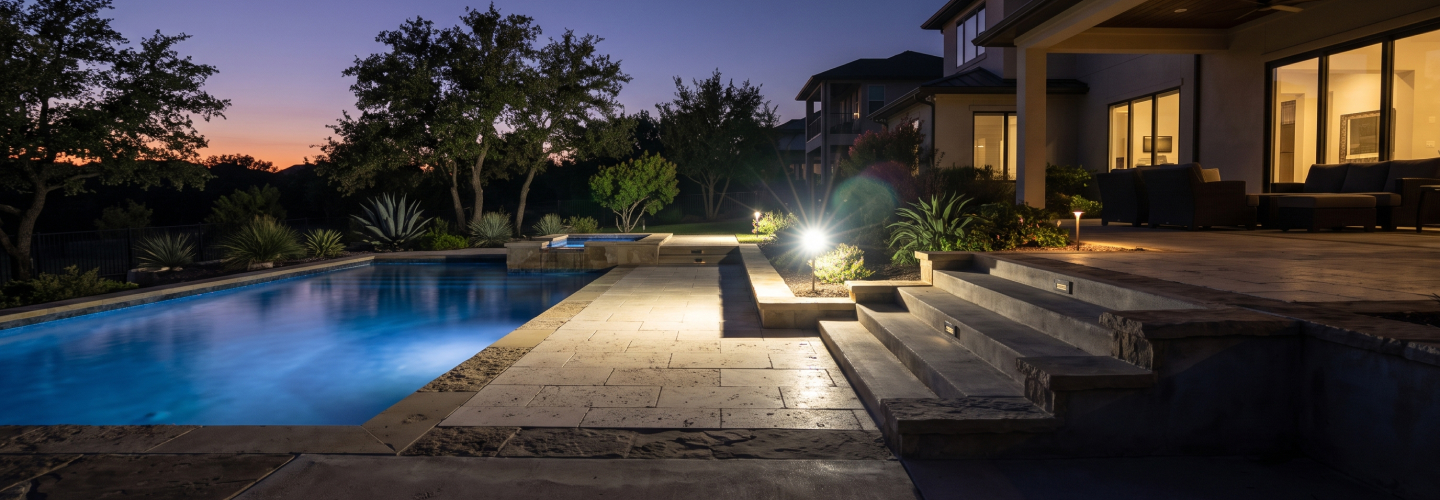
Having pool deck lighting doesn’t mean every step is easy to see. A bright patch beside a dark stair can make the walkway look clearer than it really is. What matters is where the light falls.
Misplaced lights can leave stair edges and changes in level hidden in shadow. Here’s how to spot those problem areas and make your deck easier to navigate after dark.
The Hidden Danger: How Bad Pool Deck Lighting Makes Steps Harder to See
Poorly aimed lights can create glare or leave step edges in shadow, making changes in level harder to judge. An exposed bulb shining toward your eyes can make the surrounding walkway harder to see. You might miss the edge of a step until your foot reaches it.
Underwater lights help illuminate the pool, but they don’t necessarily light the surrounding deck. Steps down to the patio, uneven joints near the coping, and paths leading from the pool gate can still sit in shadow. Check these areas separately instead of assuming the glow from the water is enough.
The High-Risk Zones: Specific Mistakes That Turn Decks Into Trip Hazards
Here are three pool deck lighting mistakes to look for:
Missing lights where levels change. An unlit step or drop-off can be easy to miss, especially for guests who don’t know your deck’s layout.
Exposed lights aimed toward approaching guests. Glare can make the walking surface harder to see. Aim and shield fixtures so the light reaches the path without shining directly into people’s eyes.
Light clustered in one section. A bright seating area beside a dark walkway leaves gaps in visibility. Check the whole route, including the spaces between fixtures.
These mistakes deserve attention beyond appearance. According to the National Safety Council, falls caused an estimated 32,500 preventable deaths in or around U.S. homes in 2024. That figure isn’t specific to pools, but it’s a reminder to take hard-to-see steps and uneven surfaces seriously.
Smart Pool Deck Lighting Ideas to Make Hazards Easier to See
Aim for clear, even light across the areas where people walk. Shielded path lights and recessed step lights can help, but their position matters as much as their brightness.
Choose mounting heights and beam angles that make step edges visible without shining into people’s eyes. Keep fixtures and cables out of the walking path so the lighting doesn’t become a trip hazard itself. Lighting helps you spot hazards, but it won’t fix them. If you have loose coping, uneven concrete, or slippery surfaces, consider pool deck repairs or renovations alongside your lighting improvements.
The outdoor-lighting principles developed by DarkSky and the Illuminating Engineering Society recommend directing light where it’s needed and avoiding unnecessary brightness.
Choose fixtures rated for the conditions where they’ll be installed, including the level of moisture and weather exposure expected at that location. For fixtures installed close to a pool, confirm that the product is listed or identified for the intended application and follow applicable electrical requirements. Check the manufacturer’s guidance on chlorine and corrosion resistance. An IP rating alone doesn’t confirm that a fixture is suitable for use near a pool.
Deck Stair Lighting Ideas for Multi-Level Pool Decks
Practical deck stair lighting ideas start with making each tread and its edge easy to see. Shielded riser lights or fixtures tucked beneath the tread above can direct light onto the step below without shining into approaching guests’ eyes.
Aim for consistent illumination across the stairs and landings. Matching lumen ratings alone won’t guarantee an even result; fixture spacing, beam spread, surface reflectance, mounting position, and the stair layout also affect where the light falls.
Outdoor Step Lighting Ideas for Safe Poolside Transition Zones
For outdoor step lighting ideas, focus on the routes people use most: from the back door, outdoor kitchen, or pool gate to the deck.
Where a wall borders the steps, recessed, shielded fixtures can light the treads without projecting into the walkway. Check the view from both directions so the light helps guests approaching from either side.
How to Plan a Pool Deck Lighting Layout That Reduces Dark Spots
Start in daylight. Mark steps, landings, uneven joints, and changes in level along the routes people use. Note any furniture or plants that could block the light.
Plan coverage around those features instead of following a fixed spacing pattern. Depending on the walkway and fixture, lights may work best on one side or both. The goal is to avoid dark gaps and make each change in level easy to see.
After dark, check the deck with its usual lights on. Use a flashlight from a stable position to explore where extra light might help, keeping enough light to move safely. Treat this as a rough preview: a flashlight won’t reproduce a fixture’s beam pattern. Have the final layout checked from both directions of travel.
DIY vs. Pro: Should You Retrofit Your Pool Deck Yourself?
Simple battery-powered or solar landscape lights that do not require electrical wiring may be suitable for homeowner installation when the manufacturer permits it and the lights do not interfere with walking routes, pool barriers, or other safety features. Once a project involves electrical wiring, permanently installed lighting, new circuits, drilling into the deck for electrical components, or work close to the pool, different rules apply.
In Texas, pool-related electrical work is regulated. The Texas Department of Licensing and Regulation advises property owners to use licensed professionals who are properly trained to perform electrical work near water. New pool electrical installations must be performed by licensed electricians working for an electrical contractor.
You don’t want to drill blindly into whatever’s underneath your deck, cut holes into your deck fascia unknowingly, or drill into a hidden sprinkler line or other utility. The Electrical Safety Foundation International (ESFI) recommends using a ground fault circuit interrupter (GFCI) for outdoor electrical devices to help prevent electrocutions and electric shock injuries. Meanwhile, the U.S. Consumer Product Safety Commission recommends GFCI protection for outdoor receptacles and receptacles within 20 feet of the water’s edge. Texas guidance likewise emphasizes GFCI protection for electrical wiring near swimming pools.
GFCI protection is only one part of pool electrical safety. Required distances, equipment listings, bonding, wiring methods, and other rules depend on the installation and applicable electrical code. Have a qualified professional determine what your project requires rather than treating a low-voltage system as automatically DIY-safe.
Frequently Asked Questions
1) How many lumens do pool deck lights need to be to meet residential safety codes?
There is no universal residential safety code that says every pool-deck or step-light fixture must produce a specific number of lumens. Lumens measure the total light output of a fixture, while codes and lighting designs may instead consider how much illumination actually reaches a surface, typically measured in foot-candles or lux.
Requirements also vary by jurisdiction and property type. For example, the International Swimming Pool and Spa Code includes specific deck-illumination levels for public pools, while its residential section directs installed pool lighting to comply with applicable electrical-code requirements rather than establishing a single lumen-per-fixture target.
For a residential deck, focus on providing enough evenly distributed, low-glare light to make steps, edges, and walking routes visible, and have the design checked against locally adopted requirements.
2) What affects the cost of adding lighting to an existing pool deck?
The number of fixtures, access to power, and installation work all affect the price. A retrofit that requires trenching, concrete drilling, or new electrical work will usually cost more than adding fixtures to an existing suitable system. Ask for an itemized quote that separates fixtures, labor, and electrical work.
3) Are solar-powered pool deck lights bright enough to prevent trip hazards?
They can provide useful accent or pathway lighting in some locations, but you should not assume a solar fixture will provide adequate safety lighting simply because the property is in Texas. Output and runtime depend on the specific fixture, battery capacity, solar-panel placement, shade, season, weather, and how much sunlight the panel receives during the day.
Cloud cover, shade, and other obstructions reduce the solar energy available for charging. If a stair, abrupt level change, or frequently used route needs dependable illumination, choose a lighting solution capable of providing the necessary coverage under the conditions in which the deck will actually be used.
Solar fixtures can supplement a lighting plan, but evaluate their nighttime output rather than relying on them automatically for critical steps or transitions.
4) What are the most dangerous trip hazard zones on a pool deck?
There isn’t a reliable universal ranking of pool-deck trip hazards from most to least dangerous. Instead, inspect the places where a person is most likely to encounter an unexpected change in the walking surface.
Areas worth checking closely include:
- Stairs and individual step edges
- Changes in elevation between different deck areas
- Uneven or settled paving and concrete joints
- Loose or raised coping
- Transitions between the deck and grass, gravel, or landscaping
- Routes around gates, furniture, and other obstacles
The most important areas on your property are the ones that are difficult to distinguish after dark or are regularly used while the surface is wet.
Make Your Pool Deck Easier to Navigate After Dark
Your pool’s glow should make the evening more inviting, and the path around it should be easy to follow. Start with the steps, edges, and dark gaps guests might miss.
Good lighting should help reveal the layout of the deck without adding glare or creating another obstacle. If you are considering permanent electrical changes around a Texas pool, have the work evaluated by an appropriately licensed professional familiar with pool electrical requirements.
For ongoing pool care, Poolie’s weekly pool maintenance service handles cleaning and water balancing so you can spend more time enjoying your pool. Contact Poolie or fill out the form below to discuss your pool lighting concerns and ask which services are available for your setup.


